Things to ponder
-
Auntie Helen

- Posts: 47
- Joined: Sun Feb 25, 2024 8:16 pm
- Has thanked: 24 times
- Been thanked: 38 times
Re: Things to ponder
This is a good point! I will update…
I write a monthly blog about life in the UK after living in Germany: https://www.auntiehelen.co.uk

-
PandaMunich

- Posts: 523
- Joined: Sat Feb 17, 2024 3:26 pm
- Location: Munich
- Has thanked: 153 times
- Been thanked: 831 times
- Contact:
Re: Things to ponder
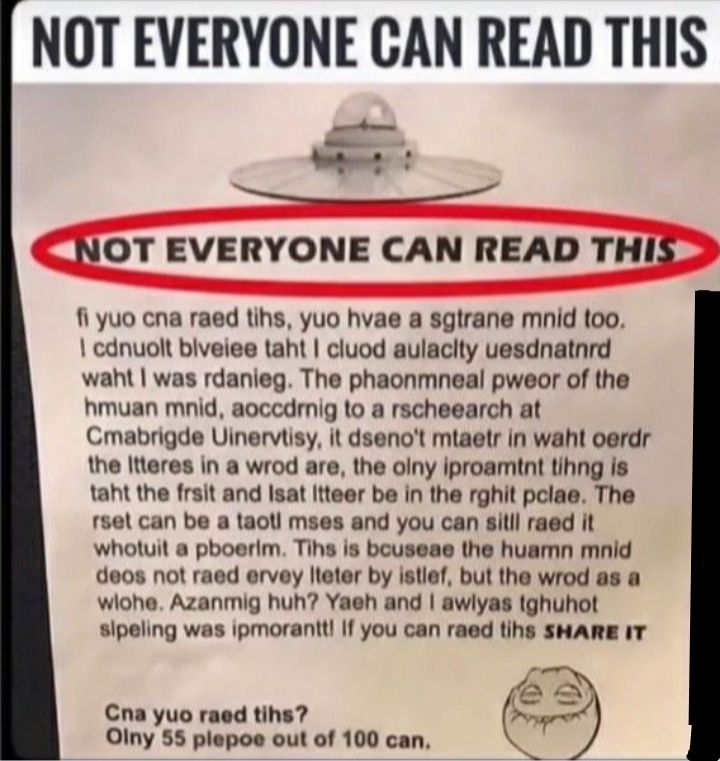
Gemini's answer to this claim:
The Short Answer
No, it is absolutely not true. The claim that "Only 55 people out of 100 can read this" is completely fabricated.
In reality, the vast majority of literate, fluent English speakers can read this paragraph with relative ease. The statistic at the bottom is a classic example of internet "sharebait"—a psychological trick designed to make you feel like you have a rare talent so that you feel compelled to share the post.
The Truth Behind the "Cambridge Study"
The text itself claims that this is based on "rscheearch at Cmabrigde Uinervtisy." While Cambridge does have an excellent Cognition and Brain Sciences Unit, they did not write this paragraph or release this specific study.
The meme actually evolved from a 1976 PhD thesis by a researcher named Graham Rawlinson at the University of Nottingham. He conducted experiments showing that people could still recognize words even if the middle letters were jumbled.
The Science: Why Can You Read This?
This phenomenon is playfully known as Typoglycemia. Your brain is able to unscramble the words almost instantly due to a few clever tricks of human cognitive processing:
Letter Anchors: The first and last letters of the words remain in their correct positions. Our brains use these exterior letters as visual anchors to quickly identify the boundaries of the word.
Predictable Context: Reading is a highly predictive game. Your brain doesn't just look at words in isolation; it uses the grammar and flow of the sentence to anticipate what comes next. Because the sentence structure in this image is incredibly simple, your brain fills in the blanks effortlessly.
Short and Function Words: Notice that many words in the text are very short (like fi, yuo, cna, taht, is, the). In short words, there aren't many ways to mix up the letters, and essential structural words are barely changed, keeping the sentence's skeleton intact.
Parallel Processing: Human brains do not read letter-by-letter like a computer scanning code. Instead, skilled readers process the word as a whole visual pattern.
When does this trick fail?
While this specific paragraph is easy to read because it was deliberately designed to be, the "rule" breaks down quickly under other circumstances. It becomes incredibly difficult to read scrambled text if:
The Short Answer
No, it is absolutely not true. The claim that "Only 55 people out of 100 can read this" is completely fabricated.
In reality, the vast majority of literate, fluent English speakers can read this paragraph with relative ease. The statistic at the bottom is a classic example of internet "sharebait"—a psychological trick designed to make you feel like you have a rare talent so that you feel compelled to share the post.
The Truth Behind the "Cambridge Study"
The text itself claims that this is based on "rscheearch at Cmabrigde Uinervtisy." While Cambridge does have an excellent Cognition and Brain Sciences Unit, they did not write this paragraph or release this specific study.
The meme actually evolved from a 1976 PhD thesis by a researcher named Graham Rawlinson at the University of Nottingham. He conducted experiments showing that people could still recognize words even if the middle letters were jumbled.
The Science: Why Can You Read This?
This phenomenon is playfully known as Typoglycemia. Your brain is able to unscramble the words almost instantly due to a few clever tricks of human cognitive processing:
Letter Anchors: The first and last letters of the words remain in their correct positions. Our brains use these exterior letters as visual anchors to quickly identify the boundaries of the word.
Predictable Context: Reading is a highly predictive game. Your brain doesn't just look at words in isolation; it uses the grammar and flow of the sentence to anticipate what comes next. Because the sentence structure in this image is incredibly simple, your brain fills in the blanks effortlessly.
Short and Function Words: Notice that many words in the text are very short (like fi, yuo, cna, taht, is, the). In short words, there aren't many ways to mix up the letters, and essential structural words are barely changed, keeping the sentence's skeleton intact.
Parallel Processing: Human brains do not read letter-by-letter like a computer scanning code. Instead, skilled readers process the word as a whole visual pattern.
When does this trick fail?
While this specific paragraph is easy to read because it was deliberately designed to be, the "rule" breaks down quickly under other circumstances. It becomes incredibly difficult to read scrambled text if:
- The words are long and complex: Try unscrambling pnoeeonmhn (phenomenon) mid-sentence.
- The letters are thoroughly randomized: Switching adjacent letters (like oredr for order) is easy to read, but total randomization (like odrer) completely disrupts our pattern recognition.
- The context is missing: If the words were just a random list rather than a cohesive story, your brain wouldn't be able to use predictive context to help you slide through the text.
-
bethannbitt

- Posts: 411
- Joined: Sun Feb 18, 2024 7:33 pm
- Location: Konstanz
- Has thanked: 1250 times
- Been thanked: 607 times
Re: Things to ponder
Context is such a major force in both language and literacy acquisition skill building. I am constantly reminded of this in my own quest to improve my German. It’s a real high when a light goes on!  One just gets better and better at filling in the missing pieces. Of course kids are thorougly amazing at it. I’m having a blast working on English with my Armenian-Germericans while hubby does the heavy lifting in German. I love this topic, as I‘m a retired speech & language pathologist.
One just gets better and better at filling in the missing pieces. Of course kids are thorougly amazing at it. I’m having a blast working on English with my Armenian-Germericans while hubby does the heavy lifting in German. I love this topic, as I‘m a retired speech & language pathologist.-
kiplette
- Posts: 283
- Joined: Thu Feb 22, 2024 5:55 pm
- Location: Weserbergland
- Has thanked: 432 times
- Been thanked: 250 times
Re: Things to ponder
I enjoyed both posts - the challenge of 'reading' the text and the explanation of what's really going on.
Very much a thing to ponder, thank you!
My schoolteacher had a party piece she did which was Cinderella and worked on a similar principle - fewer letters messed with I think...always great fun.
Quick google found it - hers was Spoonerism, where only the first letters are switched, which makes sense for storytelling rather than reading. It came from Archie Campbell originally:
'One of Campbell's 'signature' routines was to tell stories in "Spoonerism" form, with the first letters of words in some phrases intentionally switched for comic effect. The best-known of these stories was "RinderCella," his re-telling of the fairy tale "Cinderella", about the girl who "slopped her dripper" (dropped her slipper). Campbell once told the "RinderCella" story on an episode of the game show "Juvenile Jury". At the conclusion of the story, host Jack Barry said "That's one of the funniest stories Carchie Ampbell tells." All of Campbell's spoonerism routines borrowed heavily from comedy routines performed on the radio by Colonel Stoopnagle in the 1930s. ("Colonel Stoopnagle" was the stage name of F. Chase Taylor, 1897-1950.)'
Very much a thing to ponder, thank you!
My schoolteacher had a party piece she did which was Cinderella and worked on a similar principle - fewer letters messed with I think...always great fun.
Quick google found it - hers was Spoonerism, where only the first letters are switched, which makes sense for storytelling rather than reading. It came from Archie Campbell originally:
'One of Campbell's 'signature' routines was to tell stories in "Spoonerism" form, with the first letters of words in some phrases intentionally switched for comic effect. The best-known of these stories was "RinderCella," his re-telling of the fairy tale "Cinderella", about the girl who "slopped her dripper" (dropped her slipper). Campbell once told the "RinderCella" story on an episode of the game show "Juvenile Jury". At the conclusion of the story, host Jack Barry said "That's one of the funniest stories Carchie Ampbell tells." All of Campbell's spoonerism routines borrowed heavily from comedy routines performed on the radio by Colonel Stoopnagle in the 1930s. ("Colonel Stoopnagle" was the stage name of F. Chase Taylor, 1897-1950.)'
-
bethannbitt
- Posts: 411
- Joined: Sun Feb 18, 2024 7:33 pm
- Location: Konstanz
- Has thanked: 1250 times
- Been thanked: 607 times
Re: Things to ponder
I recently read aloud Roald Dahl‘s BFG to my 9-year old Armenian-Germerican granddaughter and had to modify and/or explain a lot due to his witty writing. The giant speaks funny English. Human beings are human beans and there are things like „It is so gigantuous I is needing bicirculars and telescoops to see what is going on …“.  Her 10-year old cousin recently read the Armenian translation. I wonder how that captures the humor.
Her 10-year old cousin recently read the Armenian translation. I wonder how that captures the humor.-
Fraufruit

- Posts: 1058
- Joined: Sun Feb 18, 2024 9:48 am
- Location: Munich
- Has thanked: 2189 times
- Been thanked: 1086 times
Re: Things to ponder
I remember Rindercellar, kiplette. No idea where or when but it is embedded somewhere in the mush of my brain.
-
kiplette
- Posts: 283
- Joined: Thu Feb 22, 2024 5:55 pm
- Location: Weserbergland
- Has thanked: 432 times
- Been thanked: 250 times
Re: Things to ponder
Yup, we sometimes call helicopters Bellypoppers
- his books are so cool. Some of the film versions are very good, too.